Commons · free tools for the public good
Free tools that show their working
The commons is where Foundation0 builds free, public-benefit apps, meant in time for people and small businesses who cannot pay for software, in fields such as medicine, nutrition and personal finance. Two exist today. This page explains what each one does, from first principles, and exactly how far each has come.
Two tools, eight checks
How to read: the first five rows are the commons promises listed below; the last three are what neither tool has earned yet. A filled mark means the tool does it today, a half mark means partly, and an open ring with a cross means not yet. Press the button to see only the gaps.
| Check | MedCode demo | Nutrak |
|---|---|---|
| Free, with no account | Yesno login | Yesno account |
| Your data stays on your device | Yescase text is read in your browser; only the code tables download | Yesyour food log stays in your browser |
| Works on a weak connection, or none | Partlyabout 1.2 MB of code tables to download first | Yesabout 26 KB compressed; installable; offline after the first visit |
| Shows its working | Yeseach candidate says which words it matched | Yesa “why this number?” under every target |
| Says what it cannot do | Yes“Keyword evidence, not clinical confidence” | Yesunbuilt features say so; demo data is labelled |
| Clinically validated | Not yetnot for real patient data | Not yetnot medical advice |
| Checked by someone other than its maker | Not yetno outside audit or peer review | Not yetno outside audit or peer review |
| Built for the people the commons serves | Nobuilt for US billing codes and the US market | Partlyfree, tiny and offline; but English only, kcal only, no food database |
00//Why a commons
Aska Digital essays · not peer reviewedThe money skips the public good.
Software costs almost nothing to copy, so a useful tool could reach everyone. In practice it reaches whoever someone can bill.
In The Money Skips the Public Good (19 August 2026), Aska Digital read Canada’s “AI for All” strategy line by line. Its equity, its loans and its adoption subsidies all pay for AI that can bill for itself: “Every pipeline the strategy built requires the thing it funds to be able to price its own value.” What falls through is “the AI that helps a community without a payer, the literacy that has no invoice, the inclusion nobody can bill for.” The essay’s remedy is about structure, not slogans: “make the good legally un-ownable, and then it can be funded without being bought.”
A week later, The Institution Is the Bottleneck (27 August 2026) asked why health care, schools and governments keep failing to adopt tools that work. Its answer: “a technology inherits the incentive structure of the institution it lands in, and it will not outrun it.” It ends with a test worth putting to any free tool, including ours: “who is accountable for the outcome, in what unit, and what happens to them if it does not improve?”
The commons is where Foundation0 tries to act on both essays. We are at the start. The two apps below are real, free and honest about their limits, but neither has yet been built with, or tested by, the people the commons is for. We say so in every section.
What we hold a commons tool to
01Free, with no account
Nothing to pay and nothing to sign up for; the tool is the whole product.
02Your data stays with you
The work happens on your device. Nothing personal is sent to a server.
03Small enough for a weak connection
A slow or expensive connection should not decide who can use it.
04Shows its working
Every number has a receipt: where it came from and what kind of number it is.
05Says what it cannot do
Unbuilt features say so. A guess is labelled a guess.
06Has an owner and a measure
Someone named, accountable for a stated result, in a stated unit.
Promise 03, measured: the wait on a weak connection
How to read: each bar is the time to download what a first visit needs before the tool can be used, at the connection speed you pick. Bars share one scale, and each is labelled with its time.
01//MedCode · Aska Digital
MedCode: accuracy needs evidence.
AI tools now offer to turn US doctors’ notes into billing codes, and many advertise high accuracy. Aska Digital’s MedCode study asked a plain question: who checked?
In the United States every doctor’s visit is turned into short codes before anyone is paid. The codes decide what a clinic receives, so a wrong one costs money either way: a missed code underpays the clinic, and a code the notes do not support invites an audit. Dozens of companies now sell AI that reads the notes and picks the codes.
MedCode is two things. Its research page maps 25 vendors in four camps and tags every figure in its vendor table by how well it is supported. As of 3 October 2026 it found “no publicly available independent head-to-head accuracy audit among the 25 vendors reviewed”, and adds that this is “a research finding about the sources reviewed, not a product accuracy certification.”
Its free demo searches 161,282 official US code entries inside your browser: the CMS diagnosis and hospital-procedure lists for fiscal 2026 and the October 2026 list of supplies and services. It matches keywords, says plainly that a keyword match is not a probability of correct coding, and asks you to use made-up, de-identified examples only.
What is real today
- Live
- The research page (snapshot 3 Oct 2026) and a free demo that runs in your browser, with no account.
- Data
- 161,282 official US code entries, from CMS files the demo labels historical (fiscal 2026) and the October 2026 supplies list.
- Code
- Private for now; open source when ready to ship.
- Not yet
- Clinical validation, an independent accuracy test, peer review. Not for real patient data.
The real thing
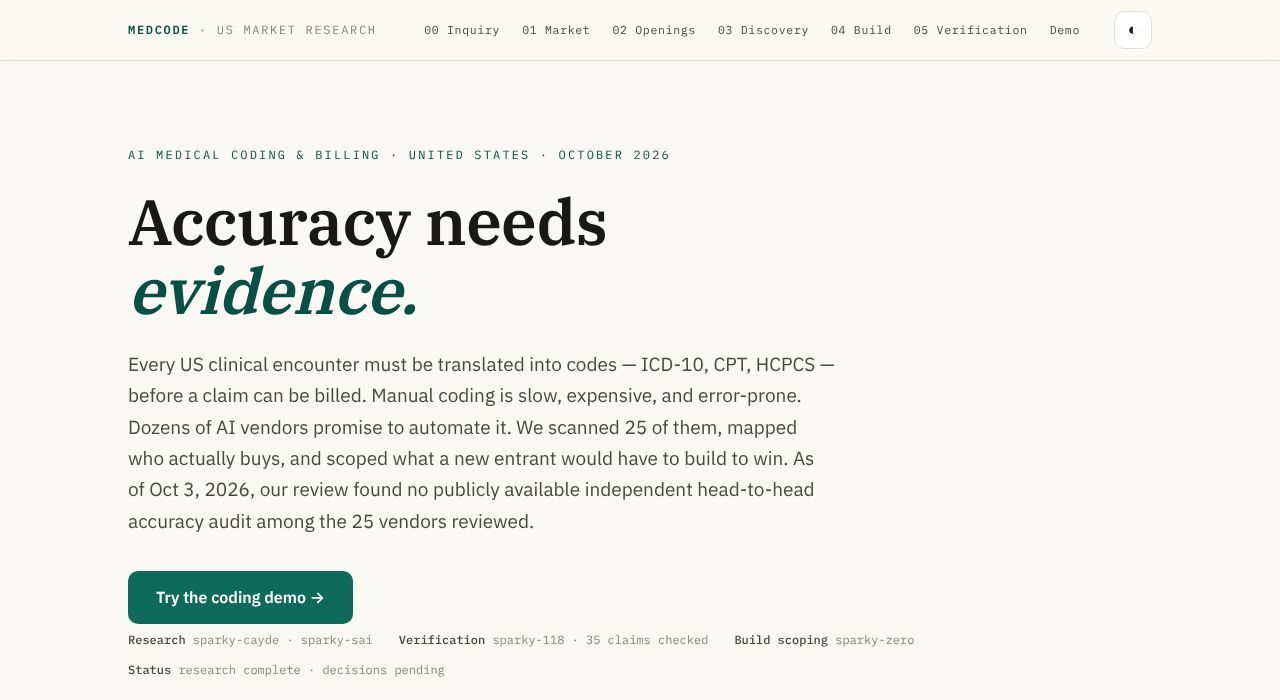 Research page · medcode.askaconsult.com
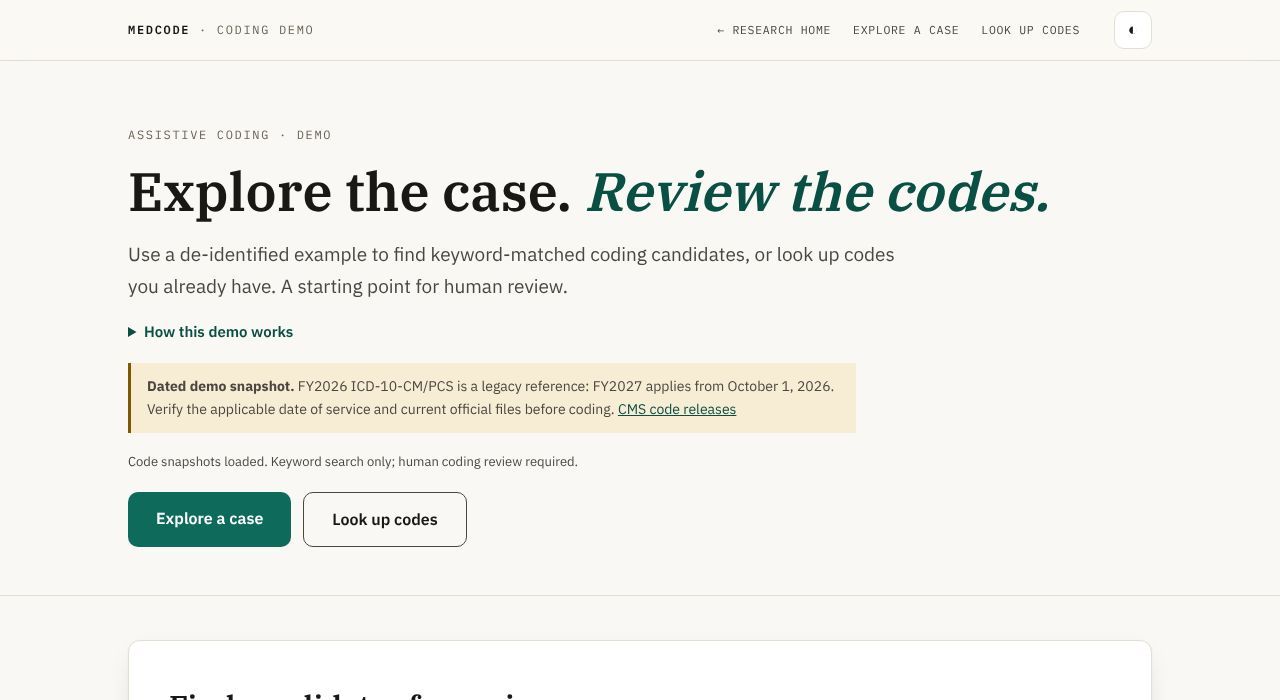 Demo · medcode.askaconsult.com/app
- 25AI medical-coding vendors reviewed, in four camps (snapshot 3 Oct 2026)medcode.askaconsult.com
- 0public, independent, head-to-head accuracy audits found among those 25medcode.askaconsult.com
- 18 of 67evidence tags in the vendor table marked verified (33 unverified, 16 vendor claim only)counted by us from the vendor table
- 161,282official US code entries the demo searches in your browser (74,719 + 79,115 + 7,448)counted by us from the demo’s public data files
The research pageTry the demoGAO-26-109116 (July 2026)CMS code files
02//Explainer · code anatomy
Real codes · CMS FY2027A diagnosis is a compressed sentence.
Before you can judge an AI coder, see what it has to get right. A billing code is not a label. It is a sentence about body, side and time, packed into three to seven characters.
The US diagnosis list, ICD-10-CM, is published by the Centers for Medicare & Medicaid Services (CMS). For fiscal 2027, which began on 1 October 2026, it has 74,879 billable codes. The first character names a chapter, the next two a category, the next up to three add detail such as cause, site or side, and a seventh character can say which visit this is. Almost right is simply wrong: a left ankle coded as the right, or a follow-up coded as a first visit, is a different sentence.
Read a code, character by character
How to read: pick a code. Each character’s meaning is listed under it; point at or Tab to a character to light its line. For the ankle sprain, change the side and the visit and watch one injury turn into nine codes.
| Side | First visit | Follow-up | Sequela |
|---|
Side and visit are often written in other words: “L ankle”, “back for a check”. A keyword search for “ankle sprain” finds all nine and cannot tell which one the note means. Watch a keyword matcher try.
Where the 74,879 diagnosis codes live
How to read: one column per first letter, height is the number of codes. The two injury letters are highlighted. Point at a column for its chapter and count.
- 55%of all codes start with S or T, the injury letters (41,187): every injury is multiplied by body part, side and visit
- 51,587codes are the full seven characters long
- 23,738descriptions contain the word “unspecified”, an honest code for “the notes do not say”
Show the counts
| Letter | Chapter, in plain words | Codes | Share |
|---|
Why matching words is not enough
MedCode’s demo matches keywords in a note, and says so on screen: “Keyword evidence, not clinical confidence.” The figure below is the simplest keyword matcher we could write, run on 270 real ankle and foot codes. It counts shared words and nothing else. Try the three notes, or write your own.
A keyword matcher reads a note
How to read: type a short note or pick one. The list shows the five codes that share the most words with it, with the shared words marked; codes with the same score share a rank (“=1”). The line below says where the right code landed.
Foundation0 illustration · not MedCode’s engineMade-up notes only
How the matcher scores
- Split the note and every description into lower-case words; drop small words such as “of”, “the” and “my”.
- A code’s score is the number of the note’s words that appear in its description. No synonyms, no word endings, no grammar.
- Rank by score; equal scores share a rank. Within a shared rank the list follows code order, which says nothing about the note.
03//Explainer · the evidence ledger
Snapshot · 3 Oct 2026Who checked the claim?
In a market that sells accuracy, the useful question is not “how accurate?” but “says who?”
MedCode’s vendor table tags each figure it reports (customers, prices, accuracy, funding) by its support: verified against a named source, unverified because it could not be corroborated, or vendor claim, resting only on the company’s own word. We counted the tags on the public page. Here they are, company by company, with the names removed: the point is the pattern, and the snapshot is a few weeks old. The names are on MedCode’s page.
67 tagged figures from 25 vendors
How to read: one row per vendor, one mark per tagged figure: a filled circle is verified, a dashed ring unverified, a diamond the vendor’s own claim. Filter by the kind of product, or dim everything that was not verified. With the keyboard, Tab to the first vendor and move with the arrow keys.
“There are few independent studies evaluating the accuracy of these tools.”
Show the counts
| Vendor | Kind | Verified | Unverified | Vendor claim |
|---|
04//Nutrak · Aska Digital
Nutrak: a tracker that shows its work.
Most trackers give one confident number and turn red the moment a day falls short. Nutrak puts a plain-words receipt under every target, and judges vitamins and minerals on a week of eating, never on a single day.
“How much calcium do I need?” sounds like it has one answer. It does not: needs differ from person to person, and what you ate is uncertain too. Nutrak’s code calls its answer a “trust contract”, with five rules:
- Every number carries a receipt. A “why this number?” button explains, in words, which official table a target came from and what kind of number it is, with 26 linked glossary terms.
- Energy is a range, never a point: 2,645–3,045 kcal a day for the demo person.
- Judge the week. Vitamins and minerals are judged on a 7-day (or 30-day) average. See why below.
- Missing is not low. A nutrient you have not logged shows “no data”, never 0% or “under”.
- A guess is a proposal. A photo estimate appears as an amber “estimate — edit to confirm” and never enters your log until you approve it.
What is real today
- Live
- Free, installable, works offline after the first visit; your log stays in your browser. Front end MIT-licensed.
- Targets
- A captured snapshot for one example person (a 35-year-old man), computed on 30 Aug 2026 by an engine that is not public yet. The numbers you type do not change them, and the app says so.
- Previews
- Photo, barcode and free-text logging. The photo flow uses a fixed example and recognizes nothing.
- Checks
- 81 trust-contract checks and 42 install-and-offline checks in the repository, all passing when re-run for this page. The public history records a reviewer’s blocking finding: the test command had been skipping the second set.
- Not yet
- Clinical validation, a user study, peer review. It is not medical advice.
- For the commons
- Free, offline and small, which suits a weak connection. But English only, energy only in kcal, and no food database, so you must know what your food contains.
The real thing
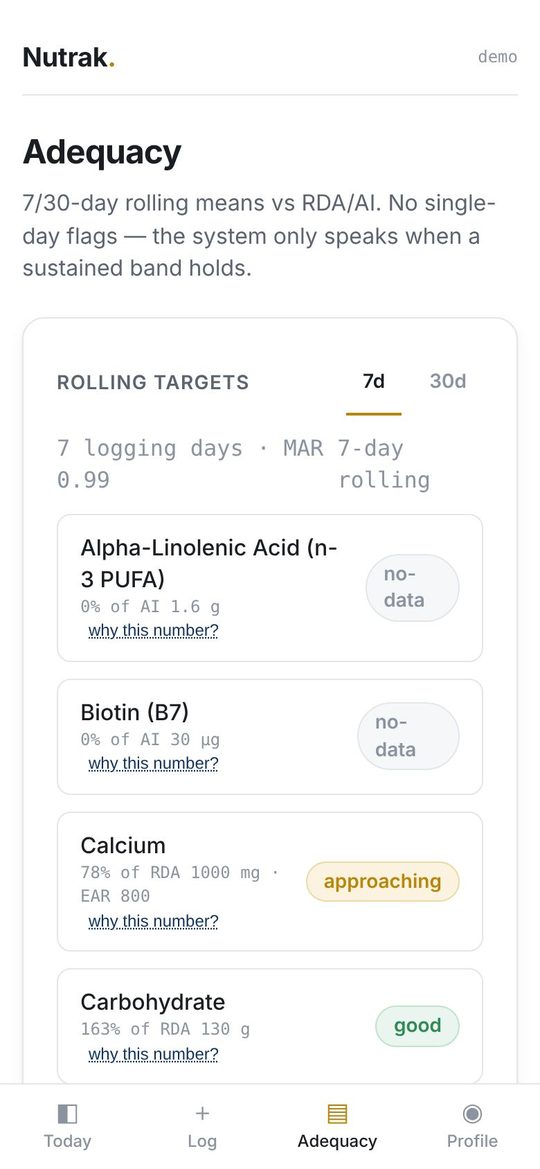
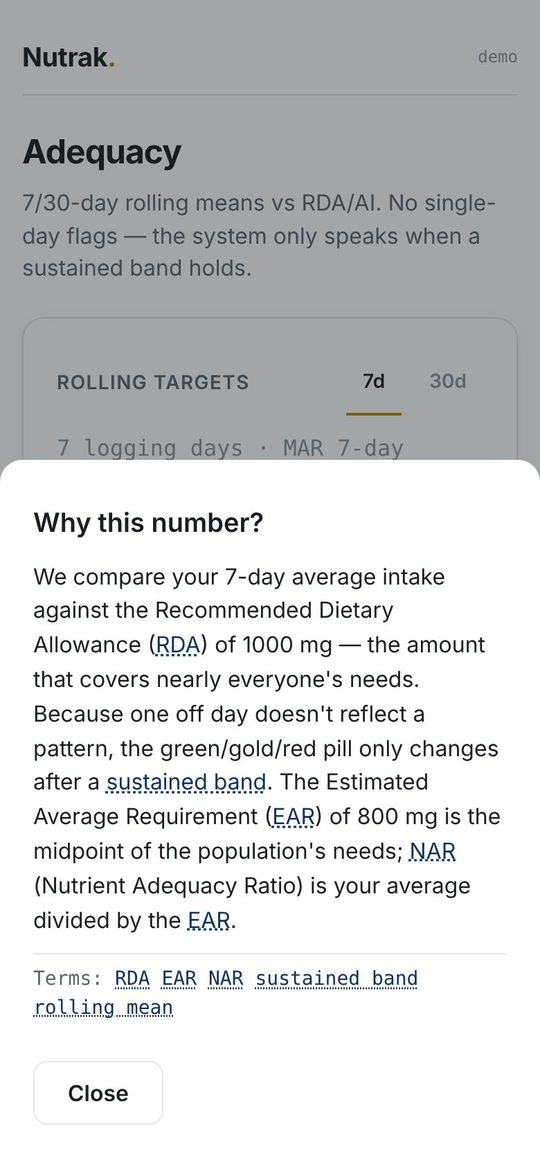
- 2,645–3,045kcal a day: energy shown as a range, never a single number (demo person)demo/fixture.json
- 5 → 1calcium’s light changes 5 times in the demo week if judged daily; the 7-day average gives one steady signalcomputed by us from the demo data
- 35nutrients with a target, each with a “why this number?” receiptdemo/fixture.json
- 26 KBthe app’s page, code, styles and glossary, compressed (86 KB raw); the demo data adds 45 KBmeasured by us, 14 Oct 2026
05//Explainer · noise and signal
Real demo data · 24–30 Aug 2026One day is noise. A week is a signal.
Your body stores calcium, so one low day says almost nothing about you. A tracker that judges every day raises five alarms in an ordinary week; one that judges the week gives one calm, honest signal.
These are the demo person’s logged calcium values for one week, from Nutrak’s public demo data. The light uses Nutrak’s own thresholds against the 1,000 mg target: below 75% is “under”, below 100% is “approaching”, and 100% or more is “good”.
Calcium, judged by the day or by the week
How to read: each column is one day’s calcium in milligrams; the shaded bands are Nutrak’s under, approaching and good. Judged by the day, the light below each column flips as the week goes on. Switch to the week to see one verdict. Then try one huge day.
Show the numbers
| Day | Calcium, mg | % of 1,000 mg | Judged that day |
|---|
06//Explainer · what a target means
Model · textbook ruleEnough for whom?
“You need 1,000 mg of calcium a day” sounds like a fact about you. It is a fact about a crowd.
Nobody can measure one person’s requirement directly, so scientists measure a group and describe the spread. The Estimated Average Requirement (EAR) is the intake that meets the needs of half the people of an age and sex: 800 mg of calcium for adults aged 19 to 50. The Recommended Dietary Allowance (RDA) sits about two standard deviations higher (a standard deviation is the typical distance of a person from the average), so it covers nearly everyone, about 97.5%: 1,000 mg. The RDA is a safety margin for a population, not your personal need. That is why Nutrak also divides your average by the EAR (its “adequacy ratio”), not only by the RDA.
How many people does an intake cover?
How to read: the curve shows how calcium needs spread across adults aged 19 to 50: most people need about 800 mg, few need much less or much more. Slide the intake: the shaded part is the people whose need it meets. The dots below are the same share out of 40 people.
Show the numbers
| Intake, mg a day | Share covered | Note |
|---|
07//The bar ahead
What would change our labelsThe bar we have not reached yet.
A commons tool earns trust the way any instrument does: by being measured by someone other than its maker.